


Ramblings and thoughts to get Overon working

In this blog post, I just let my mind go and describe what I have been doing for the last couple of years to design a single VCV Rack module: Overon.
Since VCV Rack was released, it has been my favorite platform for experimenting with all the ideas I have for synthesizers. Thanks to its open nature, I have been able to create my own modules and algorithms. With all the small pieces that I have developed (oscillators, filters, envelopes, modulators), I have architected many different synthesizers. When you have an unbounded platform like VCV Rack, you tend (or at least I tend) to create very large and complex instruments, with many oscillators, many modulations, multiple filters, etc. Something similar happens to me in the hardware world. I have many modules (mostly built by myself), and oftentimes I don't have enough cables to patch the ideas I have. I also have a large selection of 5U modules and many complex synthesizers. But it is never enough. I cannot have all my gear connected and available whenever I want to play with it.
Some time ago, I finally decided to get my hands on a Buchla Easel. I took it to our countryside house during the summer and spent a good amount of time playing with just it. It is an interesting machine: limited and, at the same time, very open. It is basically two oscillators, a small sequencer, some modulation sources, and the famous low-pass gates acting as amplifiers and filters. You can connect them in hundreds of ways, but they are still the same basic blocks. I really enjoyed making sounds on it. It is simple, open, and easy to experiment with.

Going back to synthesizer design, in the software world we are used to having very powerful synthesizers, very different from the old analog synths. That is probably one of the first criteria most users look for: How complex is it? How deep is it? It seems to me that we put too much value on the hours one has to spend reading the manuals to learn how to use them fully. I had forgotten how nice it was to play with a simple synth.
I challenged myself to assemble a simple synthesizer with modules and play exclusively with it. I started looking for a reference, and that's how I remembered the SEM from Oberheim. I had wanted to get my hands on one for a long time. I even started designing the PCBs to make a clone, but never finished them. As an initial step, I recreated it using my DotCom system: I just needed two oscillators, a state-variable filter, one LFO, two envelopes, and a VCA. That simple setup gave me a lot of joy. I created a lot of interesting sounds and made a few recordings that I saved for future use. But the SEM interface is much more minimalistic than my DotCom setup. The SEM uses a single knob for multiple functions, and everything is pre-wired. The SEM is a simple, beautiful, and effective synth design. No wonder it became the basis for many subsequent Oberheim synthesizers. For that reason, I decided to recreate it as a VCV Rack module and play with it. I wanted to experience that interface with my own hands.

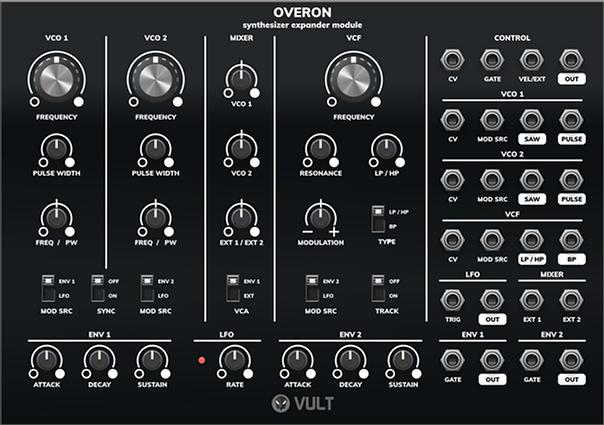
This was about two years ago, and I have finally decided to release Overon, which is inspired by the SEM. It is not a clone because I did not build and test the exact circuits. I reused many of the analog-modeled blocks I already have, such as the OTA-based state-variable filter, my analog-modeled oscillators, envelopes, and VCA.
Nowadays, with the tools that I have developed, I can create modules in a very short time, faster than using AI. I have developed my Vult language, which saves me a lot of coding, and I also have my PanelDesigner tool, a LISP-based descriptive language that I use to capture the panels and generate all the boilerplate code. I can even generate PCBs and VST modules directly from it. But even with these tools, it took me a long time to make Overon.

My thoughts are very unorganized. One day, I wake up with the idea of making a clone of the SEM as a first step and using it as a reference. Then I spend weeks capturing the circuit, looking for components, and trying to make design changes so that it works with modern semiconductors and Eurorack power levels. Another day, I decide to step back and avoid the complexity by redesigning the circuit. I spend a month studying temperature-compensation circuits for VCOs. Then I decide to use integrated circuits for the VCOs, and I spend a few more weeks working on the new design. Then I get the feeling that I have drifted too far from the original SEM, and I step back.

I waited for a couple of months, trying to buy an original SEM, but nothing showed up. Then I considered buying the Behringer version, but I felt that it would not be helpful for what I wanted to do: get my hands on the actual circuit. Then I drifted for a few months to another project. I do have many other projects in the making that have been in development for a couple of years.
At this point, I have had the VCV Rack version of Overon ready for more than a year. But I did not want to release it until I had designed a hardware version. My fear was that the hardware would end up sounding very different from the software. So I ended up making simulation models of some of the SSI chips I was going to use. That way, I could create an accurate simulation model of the hardware using the best simulator in the world (Wolfram System Modeler, which I help develop) and have a good reference for how the hardware would sound. There went another couple of months.

At the beginning of the summer, I started playing more and more with Overon in VCV Rack. At this point, I'm very happy with it. I even used my tools to make a VST of Overon, and I recorded a track using it for all the sounds except the drums. But then I connected two Overons in the same way as the Oberheim "Two Voice," and I was blown away. I have other multitimbral synthesizers, like the Waldorf Iridium, which is a very complex machine, and I often use their multitimbral capabilities. But the process is very different: I create one sound (or select a preset), then I pick another sound to play at the same time, all within the same complex interface. With the "Two Voice," it is different and more immediate: I have one sound in the left synth and another in the right; everything is on display. I tried to get an Oberheim Two Voice, but I could not find one for sale (it was good because I don't have the money to get one).

To simplify the process, I made Overon 2V, which is two Overons side by side with some extra controls to make voice handling simpler, such as unison and alternating voices.
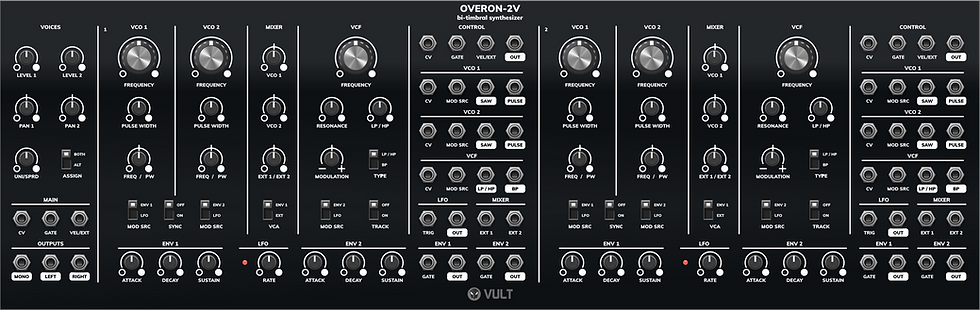
One thing I took special care with is how the randomization algorithm works. In other modules like Opulus, I implemented more controlled randomization by giving different weights to different regions of the knobs. As a result, Opulus has a higher probability of producing useful sounds. I did the same in Overon. More often than not, randomizing the module produces useful sounds. In Overon 2V, I implemented a context menu to control which part of the module gets randomized. This has been super useful for exploring sounds.
The idea of a simple, multitimbral synthesizer like Overon is not mine. I have not invented anything. It is just my personal discovery of a technology that has been around since before I was born. In this day and age, when we can materialize any idea by writing a simple prompt, it seems very important to me to try to go back to those times of innovation. A synth like the SEM could be considered underwhelming compared with the synthesizers we can get today, which provide dozens of oscillators, effects, modulations, and controls. But without a doubt, the SEM is one of my favorite designs.
By making and releasing Overon, I want to share my experience with you. Your opinion may be completely different from mine. But I would like to invite you to explore it, give it a try, and make some music with this relatively simple machine.
Overon should be available sometime after I publish this post. By releasing it, I feel like I can finally move on to my next project. I have a significant collection of projects that I would like to let go. I have some new analog filters. I have been developing effects and experimenting with new synthesizer formats. I have a few chapters of a book that I'm writing. Lots of projects. But I still need to find the inspiration and motivation to keep doing the work in the way I enjoy most: by hand. Even though AI is much faster than I am.


Very inspiring Leonardo! Looking forward to playing with Overon.... And agree about your thoughts on simplicity. There are two synth sounds I adore in this world: The Mini Moog and the SEM, and that kind of gives it away.
any chance you can port these new modules to Voltage Modular?